Tuesday, April 20, 2010

Possibly for Cashore Fans


When I pick up ARCs, it really is a digging process. But when I saw "For fans of Kristin Cashore...Tamora Pierce, and Megan Whalen Turner," I had to grab the book. Megan Whalen Turner?! I thought. She's bloody brilliant! But then I started thinking more rationally. While I might put Pierce and Cashore or Pierce and Turner together, I don't rank Cashore anywhere near as high as Turner (this is not to say that I think Cashore, if she mixes up her plot a bit more, could produce something truly good, just that she hasn't done it yet). After reading Mistwood, by Leah Cypess (out in May), I think the Cashore comparison is a good one. Full of princes, ill-gotten thrones, almost-human creatures of astounding beauty, and a pretty nest of plotters, Mistwood is very similar to Cashore's Fire, though Cashore does it better. Okay, Mistwood does not have quite as obvious an outcome as Fire, but the journey and development of Cashore's characters is much stronger than Cypess. I think one of her key problems is that the main character, the Shifter (in the guise of a human female through most of the book), doesn't know who she is. As the book is very much about her discovering who she is, it is strange to feel disconnected from her, it is almost as if she gets lost in the larger plot. Perhaps it is partially that the book is in the third person, a first person narration might have helped readers follow the Shifter's personal journey. The book isn't entirely bad, and people who like Cashore may enjoy the read, though I suggest grabbing Juliet Marillier's teen novels or Tamora Pierce's work if you haven't yet. As this is Cypess' first novel, I look forward to seeing what she may produce in the future- time and work may create something deserving of being compared to Tamora Pierce.

Maryrose Wood


I read an ARC of Wood's The Incorrigible Children of Ashton Place: The Mysterious Howling a number of months ago and absolutely adored it. But today, when I went to post on the audio book version, I discovered my total failure to post my adoration here. Incorrigible Children stars Miss Penelope Lumley, a 15 year old from the Swanburne Academy for Poor Bright Females. Penelope is educated, well-mannered, and purposeful. When she discovers the children she has been hired to care for were raised by wolves, she takes it in stride. Despite the low expectations of the foundling's parents, Miss Lumley soon has them learning manners, Latin, and how to refrain from chasing squirrels.

It is Miss Lumley's strong character and the wonderfully Gothic voice that pulled me in. The story is dark and mysterious, but also, let's face it, silly. People have been comparing it to Snicket's A Series of Unfortunate Events, and this book deserves to be compared to Snicket. The tone and length of Incorrigible Children is very similar to Snicket's, as is the middle-reader audience suggestion. And it manages to be just as dark and strange and wonderful. But don't think this is a knock-off, the adventure goes very much in it's own direction and Wood possesses a strong voice all her own. I also think the 15 year-old age of Miss Lumley, and the amount of time the reader shares with her, may also recommend the book to a slightly older (and perhaps reluctant) readership.

Now the audio book. Katherine Kellgren did the audio books for the Enola Holmes series, which I adored. Her beautifully expressive voice and accent are perfect for books written to sound like British children's classics. If I had been asked to choose the reader for Incorrigible Children, it would have been Kellgren, and we are so lucky to have her vocal skills for this audio book (now I just need to get my hands on a copy).

And now for more Maryrose Wood! While picking through an avalanche of ARCs, I came across The Poison Diaries, due out in August. It wasn't until I read the author's bio that I even realized the author was Wood (I'm sorry. I know I should remember these things, but most of the time it's the cover image that stays with me; I am an illustrator after all).


The tone of The Poison Diaries is not as much fun as Incorrigible Children, but I think that is due to the difference in audience (teen versus middle reader). While I prefer the narration in Incorrigible Children, The Poison Diaries is good. Allow me to elaborate; there is a lot of rubbish being published today as publishers look for the next big teen or crossover phenomenon. But there are gems in the rubbish heap, it just takes a lot of digging. As romantic Teen novels go, The Poison Diaries is a good one.

The book is told in the first person, and we begin listening to the narration of Jessamine, the daughter of a herbalist with a special garden devoted to poisonous plants. Jessamine is not allowed in the poison garden, despite the fact that she is no longer a child, something that grates on her nerves. But Jessamine's life is changed by the arrival of very strange young man called Weed, who, according to the keeper of a madhouse, can cure the mad and make the sane sick. Weed, Jessamine's father is assured, is mad, but her father is also certain that Weed possesses a vast knowledge of plants that should not be kept secret. But through Weed's own voice (he narrates a few of his own chapters) and Jessamine's discussions with him, we learn that Weed's skill comes from his ability to talk to plants.

The tale, based on a concept by the Duchess of Northumberland, is dark and intreguing, with a cliff-hanger of an ending indicating sequels to come. Readers will enjoy Weed's growth (it has to be a pun, horrible though it may be) and the budding relationship (ditto) between him and Jessamine. And when you throw some poison on that lot, the intrigue only increases.
Tuesday, March 30, 2010

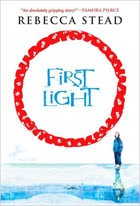
Rebecca Stead's First Light


I liked Rebecca Stead's second novel, the Newbery Award winning When You Reach Me, but First Light, her debut novel, gripped me even more. While Stead's love of Madeleine L'Engle is blatant in When You Reach Me, any L'Engle lover will recognize her influence in First Light. Think Troubling a Star meets aspects of the Wrinkle in Time series, complete with a mitochondria-studying mother and father whose scientific research takes him to strange places.

Written in the third person, First Light jumps between three characters, spending the most time with Peter and Thea. Peter is fourteen and lives in NYC with his parents. His mother, who is writing a book about mitochondria, has occasional headaches, which cause her to spend a few days at a time unmoving. When Peter himself starts experiencing these headaches, he keeps them secret, along with the strange visions that accompany them. Peter's father, a professor and glaciologist interested in global warming, takes Peter and his mother to Greenland, where he's situated for six weeks gathering data. After a few weeks, it becomes clear to Peter that his parents are searching for something more than snow statistics.

Interspersed with Peter's life are chapters of Thea's. Thea's world, Gracehope, is strange and other, a place where bowls are made of ice, and people skate from place to place; not to mention that Gracehope exists entirely underground. Thea is raised by her aunt, her mother having died in a vast underground lake, attempting to find a place where Gracehope could expand.

Thea and Peter's stories slowly grow together, and readers will enjoy piecing together their mysteries in an attempt to learn the truths that bind the two characters together.

Honestly, I enjoyed this even more than When You Reach Me. To anyone who has recently enjoyed one of Rebecca Stead's books, you will fall madly in love with L'Engle if you haven't already.

Oh- and thank you to Rebecca Stead. Now that L'Engle is gone, it's nice to see you on the scene.

Wednesday, March 17, 2010

Preview of A Conspiracy of Kings

For those of you who can't wait for Megan Whalen Turner's A Conspiracy of Kings to be released next week, here are the first chapters....

Obviously the day it comes out, I won't get any work done, until I've finished that is....

Monday, March 15, 2010

2010 Newbery Award & the beloved A Wrinkle in Time

I love A Wrinkle in Time. Actually, I love all of Madeleine L'Engle's work. And so, any book that can put A Wrinkle in Time back on the NYTimes Bestseller list is obviously a book worth reading- and, in this case, worth a Newbery.

That's right, this year's Newbery Award: When You Reach Me, by Rebecca Stead. The best description of this book is From the Mixed-Up Files of Mrs. Basil E. Frankweiler meets A Wrinkle in Time. From the Mixed-Up Files of Mrs. Basil E. Frankweiler in that the setting is very similar, NYC 1979. A Wrinkle in Time is constantly referred to by the protsgonist, Miranda, who keeps a copy of it with her at all times. The story is not as otherworldly as Wrinkle, but contains moments hinting at other-worldliness, with the possibility of tesseracts running through the novel (if you don't know what a tesseract is, it's a wrinkle in time. Read the book of the same title to learn more). But a hint of this magical science is all you need. The complex issues of friends, classmates, the hobo at the corner, and realities of being a latch-key kid all feature in the narrative.

Young readers will be smitten with Miranda's NYC latch-key existence. And while Miranda's life isn't perfect, it isn't bad. That's something I admire about Rebecca Stead's narrative, the normal issues of friends and school are enough, there's no horrible family life or abuse to deal with on top of everything.

A fifth-grade boy of my acquaintance, notoriously difficult to find books for, devoured this and loved it to the point of recommending it to others. Also recommended by middle school teachers of discerning taste and now the Newbery committee, this is not to be missed. However, if you haven't yet read A Wrinkle in Time, read it first, as it will only serve to enrich your experience of When You Reach Me.

Fairies and fairy tales (briefly)

Author Patricia McKillip came up in a book discussion with a friend of mine. We both enjoy McKillip's work and were discussing it's unique flavor.

The best way I can describe this is the classic fairy tale quality of McKillip's work. This is not due to her acknowledgment of fairytales, but in the very nature of her characters. Immortals and fairies are not human. In McKillip's non-mortal characters, there is a definate disconnet with emotion, a tendency to see only lusts and desires. Even her human character lack certain aspects of humanity; they are lost in the haze of the story, removed from even the setting's 'normal' or 'real' world, just the way heroes, heroines, princes, and queens are in stories.

After discussing characters I (being an innately visual person) moved on to visuals. The descriptions in McKillip's novels are detailed, intricate, finely woven like a tapestry or illuminated manuscript. They weave a detailed story, yet one that leaves you with the haze of a dream. A number of McKillip's books feature covers illustrated by Kinuko Craft. Craft's obsessively detailed paintings are perfect (in my mind) for McKillip's work, mirroring her connection to classic fairy tales and medieval artworks.

McKillip's characterizations of fairy make me think of Susanna Clarke, author of Jonathan Strange and Mr. Norrell and The Ladies of Grace Adieu. Clarke's fairies are devious, lustful creatures. You cannot apply human reason to them for they are not human. Her fairies want to feed their lusts, with out consideration for anyone- mortals nor fair folk. With this, Clarke creates a classically mythic, darkly pretty, and undeniably other world of fairy.

For those of you unwilling or thus far unable to delve into Jonathan Strange and Mr. Norrell, try Clarke's collection of short stories: The Ladies of Grace Adieu. The hardcover is beautifully packaged, bound with grey bookcloth. Or try the audio recording. Short stories are great in audio form, as you don't need such long periods to listen (fit one in a long commute). Also, the British vocal talents of Davina Porter and Simon Prebble are wonderful to listen to (as is Prebble's audio recording of Jonathan Strange and Mr. Norrell).

This post was brought to you by the combined powers of the audio version of The Ladies of Grace Adieu and a library book sale copy of The Changeling Sea.

Any other comments on faerie? Or books you think do a nice job at portraying the darker aspects of faerie? I haven't read much Charles de Lint, but I think he may...

His Dark Materials

I was recently asked by an adult if Philip Pullman's His Dark Materials was worth reading and, if so, would I place a post on my blog?

I can't believe I didn't. I guess I simply assumed it was there. Perhaps it's on the original list and never made it online? Yes, it is. My apologies.

Before I get on with this, His Dark Materials is worth reading, but you should have the next books on hand as you read as many of you will be most upset by the cliffhanger endings of the first two books.

Now for some specifics. His Dark Materials is composed of three volumes: The Golden Compass, The Subtle Knife, and The Amber Spyglass. You have to read them in order.

The Amber Spyglass, the third book, won the Whitbread Award (now The Costa) in 2001, for best children's book. It also won the overall category, becoming the first book in a children's category to do so. Due to this, its' readership, and Pullman's claim that it is "Paradise Lost for teenagers," it was one of the books to bring on the new spate of crossover fiction. (For those of you unfamiliar with the term, crossover fiction is used to refer to children's books read by adults, or adult books read by children. As this is an extremely pertinent topic in contemporary lit, and was the topic of my minor's thesis, I will post the thesis here (later) for those of you with the time and inclination).

The books are dark adventures and, true to many great young adult books, feature a coming of age story. Like science-fiction, His Dark Materials explores concepts of religion versus science. In this world, a fantasized version of England, one's soul is external, taking on the form of an animal. As a child this animal soul, called a daemon, changes form, though it drifts toward a favorite form as children mature. After going through puberty, the daemon picks a form. Daemons can interact with one another, but you would never touch another person's daemon. The daemon's physicality makes struggles over souls (whether being used to stop sin or fuel science) more dynamic and graphic. Add armored bears, gypsies, balloonists, a world-rending knife, and a compass with unusual capacities, and you are off on an adventure of staggering breadth. Indeed, take a deep breath (okay, I know that's cheesy- deal with it) before diving in- you may not surface until the end.

Incidentally, when I heard the third book was to be released, I cajoled the shcool librarian into giving it to me the day after it was released- before it even had a date card or had been wrapped in plastic. I returned it the next morning, having not slept that night (who needs boring middle school when you have brand-new top-notch literature?).