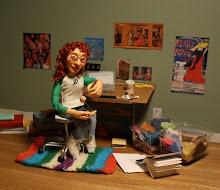
I received an email a few weeks ago asking this question, and quickly found myself composing an answer. So, if you find yourself wishing to know, here goes.
I have cultivated people whose opinions I respect, who I think know my taste and can be relied upon to recomend books I will truly enjoy. Buying books, I've come to recognize certain publishers and imprints that have lists I feel are very strong. After buying and reading several strong lists from Candlewick, I'll read anything published by them- even a YA novel on angels (which I really enjoyed, but never would have picked up on my own). Recently, I've been picking my way through my local library's graphic novel shelf, pulling anything published by First Second. Last winter, in the course of two weeks, I read three books by First Second, looked at their author/illustrator roster, and fell in love. Publisher reps recommend and hand me more books than I can ever hope to read. Some are announced as "the big book of the season," some are by authors I love, and others are virtual unknowns, handed to me by reps, read over lunches, truly enjoyed, and eventually hand sold in the store. Talking with people at a children's literature conference recently, I emphasized the importance of recognizing the merit of a book even if I didn't enjoy it. I can recommend and sell books I don't like if I think they have literary merit and there is an audience for them. In grad school, I think this is the main difference between people who have only read children's books for enjoyment in the past and those who work closely in the field- we who work in the field can personally detest a book, but realize it's importance or it's selling power. For the others, this is something that must be cultivated.
Showing posts with label writings on reading. Show all posts
Showing posts with label writings on reading. Show all posts
Thursday, August 25, 2011


Wednesday, February 18, 2009
Rubbish as Reading
Rubbish is read a lot. I don't have a problem with this, I simply have a problem with giving horrible messages to tween and teen girls, who already have enough problems and hormones that they don't need bad messages and examples on top of it. What am I referring to? The Twilight series, the blockbusting book and movie I wanted nothing to do with. Unfortunately, their popularity caused me to take notice, not because they were getting girls to read, but because they promote abstinence, self-depreciation, and unhealthy relationships. A very good article can be found in Bitch magazine (a feminist response to pop culture) here:http://bitchmagazine.org/article/bite-me-or-dont
I am currently reading the books (slogging through is more like it) so that I can write a more thorough article on them. Meanwhile, I encourage open discussion about the bad examples found in these books and a shift to more empowering fiction (Alanna, anyone?).
Series Or the Missing Books
I am sitting at my computer in New York searching the online card catalog of my library. Julie is in Massachusetts, sitting at her computer and looking at the online card catalog of her library. And every time I come across something I’d absolutely love to read, a little window pops up on Julie’s screen saying something to the effect of, “this is absolutely amazing. The imagery is gorgeous and it made me cry.” Or, “damn it! Why do they never have the first book in the series!” And Julie will type something back to me along the lines of, “Let me see if I can inter-library loan it.” Or, “I know! The third and the fifth aren’t much good without the first.”
What can be determined from these brief examples of our conversation is that (1) we read a great deal, (2) we prefer to read our series in the correct order, and (3) public libraries have a terrible habit of buying books with no regard to their order in a series. This last conclusion is the most important of you are a public librarian. If you are a public librarian, I suggest that you do a complete sweep of your library and fill in the gaps currently present in your series. This means that if you own the third and fifth books in a series (which I have found to be the most common volumes in most libraries), you must buy the first, second, and fourth books in the series.
Now, if you find that your search is not turning up these anomalies in your collection, I suggest that you skip ahead to science fiction and fantasy, where this problem seems to be an epidemic. If you are still finding that all the volumes in a series are present in your collection, you are either not looking correctly and should therefore find a nerdy teenager to help, or you should be congratulated for actually buying books in the correct order.
To be fair to librarians, book buyers, and booksellers, I will admit that some authors do make it awfully difficult to keep a series in order. For example, why does the Hitchhiker’s Trilogy by Douglas Adams have five volumes? And is C.S. Lewis’ the Lion the Witch and the Wardrobe the first book in the Narnia series, or the second? The answer to the first question is you should never trust science fiction writers as their minds spend most of the day in outer space or on other planets. The second answer: we wanted answers as to Narnia, and we got them in the form of a prequel. As The Magician’s Nephew is delightful story, and answers our questions, you should not complain about so inconsequential a problem as the order of the books.
As to the problem of figuring out what books in a series your collection is missing, the answer is quite easy to find. If you are anti-computers, I would suggest going directly to the root of the problem: the books themselves. Most, if not all, books in a series will display their position in a series on the spine, the cover, or inside the book on a page listing other books by the author. If, like me, you are sitting at your computer, or if the numerical information cannot be found on the book, Amazon is your next best bet.
I adore Amazon. Yes, I know it is a mega-corporation that will someday beat out all the lovely little independent bookstores, but I still love it. You can find everything, and I mean everything, even the out-of-print lovelies you thought you’d never seen again and the books that won’t actually be released for a few weeks. But I’m sidetracking. You can search any and everything on Amazon. So, the simple way to find the gaps in your collection is to plug in the author or title of the books you are searching, and bing! Up will pop a nice window giving all the information you could ever wish to know about the book, including if it is in a series, and then you can even find the other books in the series. And, get this, you don’t even have to launch another search- generally, you can just click a link. Sometimes I do love technology. Just think, you could order the book, have it in less than a week, and have it on the shelf…. Oh, yeah. I forgot about the process part of actually getting the book on the shelf…but I’ll deal with that later. According to the web, my library actually has the first in a series Julie recommended….
Reading During Dinner
I read too much. I have always read too much. I am sure most parents say they would be over-joyed if their children read too much. But the fact is, when it actually happens, it’s not what you think it will be. I’m not saying my parents weren’t happy that I read too much, but they did spend a rather large amount of time telling me and my brother to “put the book down and come eat dinner.” Now, if we had simply put our books down and gone running to the dinner table, I don’t think there would be as much trouble as there was. Instead, we would have to finish the page. But here’s the catch, on how many pages does the paragraph end neatly at the bottom? Very few, I should think, and therefore we’d have to finish that paragraph also. But when you’re gulping down fiction, the ends of paragraphs aren’t exactly noticeable, and so “just let me finish this page” would really end up becoming, “just let me finish this chapter.” And now, any book-lover will be asking, “but why stop there?”
Why indeed? I believe that by the age of ten or so, I had trained myself to ignore chapters. By that point, I didn’t really see what the purpose was to have chapters, for I had no problem sitting down and reading until I finished the book. I still have no problem doing this, though now these one-sitting books have gotten much longer and therefore often last until the wee-hours of the morning. But back to dinner.
So, my brother would continue to read, through the end of the page, the end of the paragraph, and, indeed, the chapter. Furthermore, we would be so absorbed, we wouldn’t hear my mom yelling at us to “just drop the book and come eat.” Eventually we’d make it to the table, though throughout dinner we would pine after the books we had put down, or, more precisely, had ripped out of our hands.
Nowadays, I would say most parents have to tell their children to turn-off the tv and do their homework. In my house, it was, “put down the book and do your homework.” This phrase sounds quite odd. Put down a recreation you love and learn from to do homework that bores you. Maybe even, put down the classic children’s novel to answer questions on a book you read three years ago and hated because you said the characters were underdeveloped? Right. That makes perfect sense.
Reading for school was always difficult. I don’t mean that the reading itself was difficult, or the questions complicated, that problem was that I read too fast and understood too much. In schools, it is quite common for a class to take at least a month to read or study a book. It would take me a day to read that same book. A week, tops. This meant, by the time the questions were handed out, or a project needed to be done, my memory of the book was at least three weeks old, and my mind was concerned with some new adventure.
I remember getting in trouble for reading ahead while the class was reading aloud. Examples from third grade come to mind, as do examples from tenth grade. The teachers would make us read “pop-corn style” students would be chosen at random to pick up reading the book. This method was used to ensure that everyone was actually reading the book. My problem was that I while I was reading the book, I was most likely a few chapters ahead of the class.
At this point I really must comment upon reading aloud; some people just don’t read aloud well. I have listened to some amazing readers in my time, my mom, for one, my good friend Anna, another. Anna and I used to read Shakespeare aloud together simply because it was so much nicer aloud. In audio books, it is mostly the voice that makes for a good listen. I have listened to books I hated to read simply because the reader had a fabulous voice. I’ve also had to turn off books that rank among my most lent simply because the readers were so awful.
In school, you cannot simply hit the stop button. Therefore, I became very good at tuning out the rest of the world. I have become so good at it, in fact, that you can dance in front of me and yell my name at the top of your voice, and I wouldn’t even know you had done it when you finally caught my attention. This ability is not exactly cheered by teachers. In fact, they rather hate it. Especially during pop-corn reading.
“Your answer is too long. Go back to your seat and fix it.” Come again? You think the answer to the comprehension question is too long because it has too many examples and is written in complete sentences? So you’re telling a second-grader that she comprehends the reading too well. Since when has comprehension been a crime? (Yes, since politics began comprehension has been a crime. But I’m not talking about politics; I’m talking about elementary reading lessons.)
Now, my second grade teacher was a lovely lady, I have absolutely nothing against her. I’m just asking why a second grade teacher, or any teacher, for that matter, should have a problem with a student writing complete sentences and using examples from the text to back up her writing. Time wasn’t the issue; it took me less time than most of the other students. Even now, I have no idea what the issue was. But I do know that from then on, I did the smallest amount of work possible to get an A. Yes, it is sad, but it gave me more time for my greatest love, my greatest passion, reading what I wanted to read.
Subscribe to:
Posts (Atom)